April 21, 2011

Update

Jerry mowing the 18th green

Today could be the fifth consecutive day without measurable rain at Sandpines.  There is a brief shower possible later this afternoon, so we will have to wait and see how it pans out.  We had frost delays on Monday and Tuesday due to temperatures in the low 30's.  Now that May is right around the corner, hopefully frost delays are behind us for a while.  The course is drying out nicely with the good weather, but there are still some wet areas around, so be careful with those carts.  The forecast for next week seems to change drastically with each day that passes, but it looks like there will be a couple of descent days and a couple of wet days.

Jerry mowing rough on hole 14

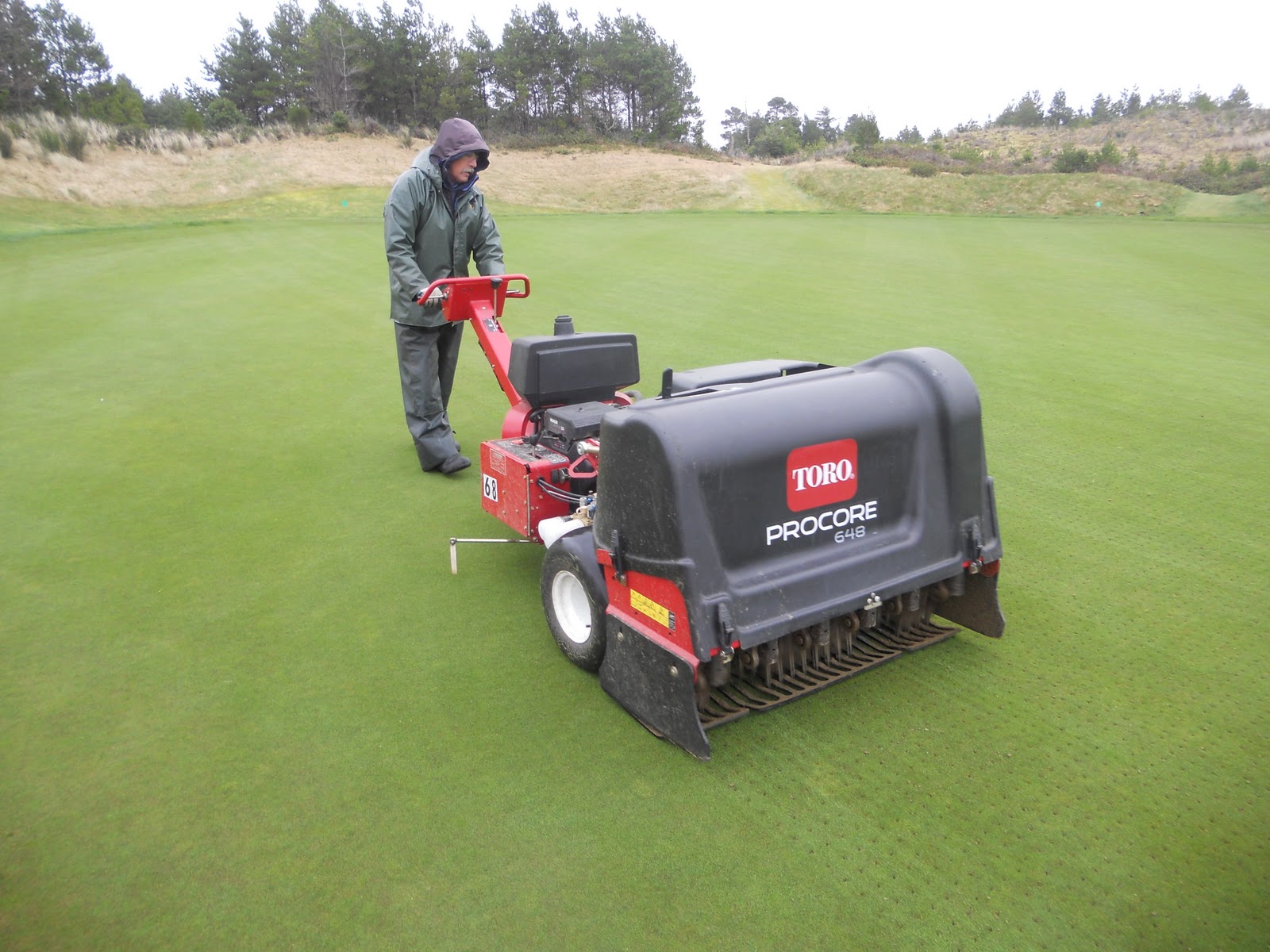
This week we spent most of our time performing routine golf maintenance tasks.  Routine golf course maintenance tasks include:  changing hole locations, mowing all areas of the golf course, raking bunkers, and maintaining equipment.  It was nice to be able to get the fairways and rough mowed again this week.  We were also able to get the fairways fertilized.  We are scheduled to start greens aeration in 10 days, so our focus outside of routine maintenance tasks has been making sure the aeration equipment is ready.  Dean made some modifications that should improve the reliability of our core harvesting equipment.

The driving range tee is now open.  I saw a video on David Phipps blog (Stone Creek Golf Club) that showed a great way to utilize driving range tee space.  In the video, Dan Meersman of Phily Cricket Club compares three divot patterns.  I liked Dan's idea so much, I included his video below.  It is definitely worth a look.  Let's see if we can implement the preferred hitting pattern in the video at Sandpines.


April 14, 2011

Update

Mowing fairways

I always enjoy watching the Masters.  I was so inspired after television coverage ended Saturday that I decided to head for the golf course.  It was a beautiful day, so I thought it would be nice to sneak in a few holes.  Instead of grabbing my clubs, I opted for my work keys.  Sure enough, I was able to get out and mow a few fairways.  It was definitely worth it.  Between Saturday morning, Saturday afternoon, and Sunday morning, I was able to get all the fairways mowed.  Usually, I would not consider that a major accomplishment, but this year the weather has been so awful that finding a dry enough time to mow fairways has been a challenge.  With the exception of tomorrow, the weather forecast for the next 10 days looks pretty decent in Florence.  I really hope that forecast holds true.


Shrinking vinyl onto a flagstick with a heat gun

I am always looking for ways to be more efficient and utilize resources wisely.  I had heard of a company called Vinyl Guard making some type of wrap that could be put onto flagsticks in order to reuse them.  I got serious about the idea after seeing the flagsticks that David Phipps produced at Stone Creek Golf Club.  After checking into the details involved, I decided we would give it a try at Sandpines.  I finished the flag sticks this week.  They turned out pretty nice.  Before I fully endorse the product, I want to see how they look after a full season of use.  In addition to the vinyl shrink wrap, new ferrules were also installed. 


New Flag stick preview

With vinyl, ferrules, and paint, the cost to refurbish our flagsticks was about $6 each excluding labor.  New flagsticks of a similar type sell for about $28 ($26-$30) each.  We usually order 20 flagsticks due to theft and/or damage.  That brings our usual flagstick total to about $560.  Our 20 refurbished flagsticks cost about $120.  The new flagsticks will most likely be put out after greens aeration, which is coming up soon (May 1st, 2nd, and 3rd).


Used pin sheet I found online

Recently, I needed a blank pin sheet for an upcoming tournament.  After looking through my computer files, I came up empty.  I decided to search for one online.  I did not come across a blank one, but there was a used one I liked.  I decided that would do.  The pin sheet I found was in jpeg format.  This made it relatively easy to modity.  I was able to transform the used pin sheet above into the blank pin below using Microsoft Paint (MS Paint).  If you ever want to modify a picture give MS Paint a try.  The process is pretty easy.  First, open MS Paint.  Next, open the file you want to modify within MS Paint.  Then, perform your modifications and save.


Blank pin sheet

April 8, 2011

Blue Sky Returns!

14 green basking in the sun

Today the sun is shining at Sandpines.  We had a brief frost delay this morning, but it was well worth the opportunity to enjoy the sunshine.  Sandpines has received just under two inches of rain over the past week.  Soil temperatures are beginning to increase, and so is turf growth.

Steven clearing brush next to cart path


Greens were rolled once, and mowed multiple times this week.  Tees, approaches, and most areas of the rough were also mowed.  Fairways were fertilized.  Tee yardage markers were edged.  Brush was cleared away from the cart path on the blind corner from 12 green to 13 tee.  Collars will be mowed over the weekend barring any unforeseen circumstances.

Jim edging a tee yardage marker on hole 13

We continued to work on extending carth paths this week.  A much needed extension to the cart path on hole 12  was completed.  We also began refurbishing flagsticks this week.  I will include more on the flagstick project in an upcoming post.


Jerry working on hole 12 cart path extension

March 31, 2011

Will It Ever Stop Raining?

Flooded cart path on hole 7

Today the weather was supposed to be sunny.  Unfortunately, we had constant light mist instead.  Today marks the 27th day of the month with measurable precipitation.  Hopefully, April will be a drier month.

Screen shot showing where to click for precipitation history

Speaking of precipitation, I added a new page called precipitation history.  The page is located at the top of the blog.  The home page contains blog posts, while the precipitation history page lists the precipitation measured at Sandpines.  I will update it monthly to keep it current.  The history goes back to June of 2006.  You can check it out by clicking on the precipitation history tab at the top of the blog (see the picture above).

Jerry top dressing hole 5 green

Despite the wet weather, we were able to top dress greens on Monday.  The approaches were also top dressed, but had to be spread over three days due to heavy rain on Tuesday.  I usually like to lightly top dress greens and approaches monthly from November through March.  But, that has not been possible with all of the rainfall over the last few months.  As the weather gets warmer, we will be top dressing on a more regular basis to incorporate sand into the thatch layer and to smooth the surface of the greens

Hole 4 green side bunker holding a little water

As of this morning, we had 19 bunkers with a least some standing water.  A couple of people have asked me if the water can be pumped the out of the bunkers.  The standing water in the bunkers is from ground water.  The water can be pumped out, but as soon as the water is gone and the pump is turned off, the water returns.  The picture above of  hole 4 green and bunker was taken this morning.  The bunker was pumped out yesterday.  We only received about a quarter of an inch of rain since the bunker was pumped and the water level is right back where it was yesterday.  As the level of the ground water goes down, the bunkers will again become playable.  It will most likely take a few months for the lowest bunkers, such as those on hole 4, to get to that point.

Can you tell which red stake has been painted recently?

Our red hazard stakes were in need of painting.  We spent some time over the past week refurbishing and painting all of the red hazard stakes throughout the golf course.  The difference is pretty dramatic.  The yellow hazard stakes are not as noticeable, but they could also use a fresh coat of paint.  Hopefully, we will get a chance to paint them soon.

March 24, 2011

Update

Steven tidying up pampus grass

The weather over the past week has been drier than the previous week.  However, Sandpines still received 1.15 inches of rain.  Unfortunately, the weather forecast for the week ahead looks wet.  On a positive note, we were able to get the fairways mowed during our 40 hour stretch of nice weather earlier in the week.


Broken splice box

Jerry and I continued our quest to find the fault in the power wire which supplies power to 3 irrigation control boxes between the driving range and hole 2.  We had it narrowed down to a two square foot area in short order.  The problem was a broken splice box on the driving range fairway that was just inches below the surface.  Since, there was no access box present on the surface, we had no idea the splice box even existed.  Consequently, it had been aerated and destroyed over the years.  There was a nick in the common wire that had caused the circuit breaker to trip.  Typically, there would be a way to access the splice box from the surface, much like a valve box gives access to below ground irrigation valves.  The wires were re-spliced and sealed in a new splice box. An access box was also installed flush with the ground.  The addition of this box will provide convenient access to the splice box.  Additionally, the access box will be visible from ground level, and therefore, will be avoided during aeration.


River rock 1-2 inches below the surface of the turf?

There have been many people that have worked at Sandpines over the years.  These many people have had many ideas.  Like all people, there were good ideas and bad ideas.  Putting 6 inches of river rock just 1-2 inches below the surface of the turf 5 feet away from a green was a bad idea.  Needless to say,  aeration of this area has not been successful, unless you have a use for broken tines.  Steven did a nice job digging up the first of  two river rock "drains" next to the 18th green.  Luckily, there are only a few more of these types of "drains" throughout the golf course.

For those of you out there looking to put drainage in a turf setting, please use pea gravel instead of river rock, it will be much easier to deal with in the future.  Also, cap the pea gravel with 4-6 inches of sand.  Additionally,  if you are on top of a sand dune, start with improving infiltration (remove thatch), as sub surface drainage is likely to be pretty good.


Extremely wet area in hole 6 rough

The golf course is as wet as I have ever seen it.  The last couple of winters, the ground water did not surface on the golf course.  This winter its back with a vengeance.  We had no choice but to implement the rope and stake traffic control strategy.  I prefer using only green traffic control stakes, but there are simply to many large areas that must be avoided by all traffic.  One area that has suffered greatly with the arrival of ground water is hole 6.  The low spot in the fairway that is approximately 70 yards from the green must be roped off.  This forces all the golf cart and maintenance equipment traffic to travel through the right rough until the gravel cart path is reached.  Conditions in this area have gotten much worse this year than is previous years.  Jerry is working on extending the gravel path in this area in order to keep cart use available.

There are many areas of the golf course which should be avoided that have been marked with a mixture of ropes and stakes and stakes alone.  If you happen to be using a cart while golfing a Sandpines, please avoid these areas.  During heavy rain squalls, there may be additional standing water on the course.  All standing water should be avoided if at all possible.  Every effort will be made to provide the use of carts, however, there are times when it is simply not possible.

Something that drives me crazy is seeing excessive cart use.  An example of excessive cart use is 2 golfers using 2 carts (4 golfers using 3 carts and 4 golfers using 4 cars are also excessive cart use).  The only time excessive cart use is tolerable, is when players have joined up on the course.  That does happen now and then.  However, there are many times this is not the case.  Please consider the wear and tear on the golf course.  Excessive cart use definitely has an impact on course conditions.  Not to mention, wasting energy to charge an extra cart, and having to wash an extra cart.  Joining up at the range?  Please take a moment to drop any extra cart or carts off at the cart circle before you tee off.  Join up on the front nine?  Please drop your cart off at the cart circle before continuing to the back nine.

March 18, 2011

Rain, Aeration, and Irrigation?

High water on hole 4

It has been another wet week at Sandpines.  The golf course has received 3.36 inches of rain over the past week.  The precipitation total for March is up to 8.25 inches.  Next week looks better, but there is still some rain in the forecast.  Like everyone else in the Pacific Northwest, I am ready for drier weather.


Solid tine aeration

The greens have been in good shape this winter.  However, the seemingly constant rain has led to puddling of greens on many holes.  The puddling subsides after the rain stops, but it seems to take longer after each rain storm.  Since play was light due to the awful weather earlier in the week, we took the opportunity to aerate the greens with solid tines.  The improvement in infiltration was immediate.  The holes will be visible for a few days, but the positive impact on infiltration will last for a month or more.


Improved infiltration

I took the picture above during a heavy rain squall that occurred while I was aerating the ninth green.  If you look closely, you should be able to see a difference between the left and right side of the picture.  The left side had not yet been aerated, and there is water present on the surface of the green.  The right side, which had been aerated had no surface water present.  As I continued aerating the green after taking the picture, the remaining water on the surface of the green was gone within seconds of being aerated.


The video below is from the USGA.  It gives a pretty good two minute explanation of why superintendents aerate greens.


Jerry and I (mostly Jerry) also worked locating a faulty power wire that provides power to 10 irrigation control boxes this week.  We are still in the process of solving the problem, but we have narrowed it down to one wire and 3 control boxes.  We are hoping to locate the fault in the wire next week.  I don't think we will need to irrigate anytime soon, so in a way its not the worst time to have an irrigation problem.  Far better timing than the hottest week of the year, which seems to be when many irrigation problems arise.


Jerry in problem solving mode

March 11, 2011

Update

Hole 14

The tsunami warning siren sounded at 3 am this morning in Florence.  We were fortunate to escape any tsunami damage, but the weather has been pretty wet the last couple of weeks.  Sandpines received 4.65 inches of precipitation in the first ten days of March.  The precipitation total for February was 6.16 inches.  There is a little break in the wet weather today, but the rain is supposed to return tonight.

Wind blown tree debris

The rain has kept the course pretty wet.  Windy days have kept us busy blowing debris off greens and approaches.  Over the last two weeks, we have continued working on  adjusting the height of sprinkler heads.  We have also been working on draining wet areas with our unique drainage techniques (see November 9, 2010 post for more information).

Old debris pile under hole 4 fairway

The picture above was captured while I was using a post hole digger to drain an area at the start of hole 4 fairway.  Apparently,  this was a site for an organic debris pile prior to becoming a fairway.  These types of areas are rare at Sandpines, but we do run into once in a while.  There were several sticks in each drain hole that were removed.  The hole were then filled with sand.  This area should begin to dry up fairly quickly if the rain ever stops falling.